













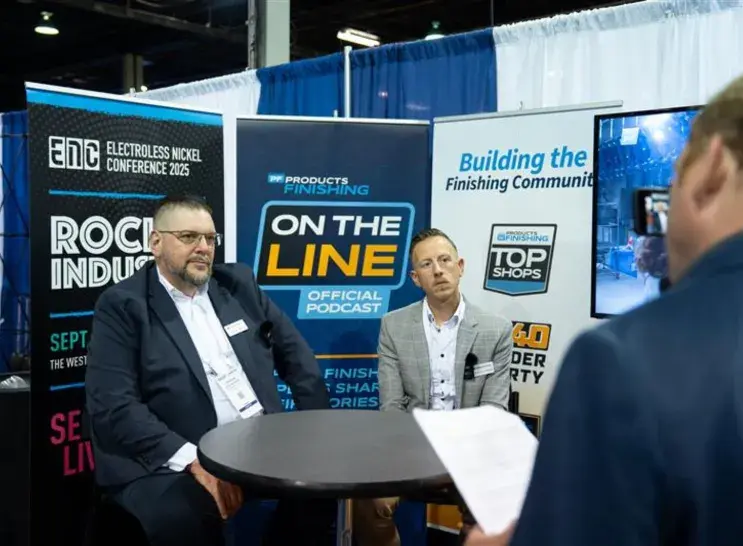
In this latest installment of On the Line, Products Finishing (PF) explores some of the latest trends in electroless nickel (EN) plating, both in terms of challenges as well as innovations and opportunities. At SUR/FIN 2025, PF sat down with two experts from MacDermid Enthone Industrial Solutions (Waterbury, Connecticut): Douglas Hughes, wear-resistant coatings industry manager and Ambrose Schaefer, global product line manager for EN, to hear their thoughts on this unique area of surface finishing.
Products Finishing (PF): Can you talk about current supply chain challenges the industry is facing and what's being done to address them?
Douglas Hughes (DH): From a supply chain standpoint, I don’t know that there are any issues supply wise — there have clearly been some issues with certain raw materials across the spectrum of plating over the last few years, but from a standpoint of electroless nickel [EN], the supply isn’t the problem. Rather, it’s the cost of the raw material and the narrowness of the supply chain relative to sodium hypophosphite. Ninety to 95% of the supply of hypophosphite comes from China — and that certainly can present some issues. At MacDermid, we’ve been trying to carefully navigate and be savvy about our ordering patterns when it comes to sodium hypophosphite, and we keep a robust inventory of material. But it’s been a challenge, no question.
When the tariffs were in place at 145%, that was really 172% because there were already existing tariffs on hypophosphite. Luckily, we had a fairly robust supply of material, so we really haven’t had to pass through any kind of the tariff charges to date. It doesn’t mean it won’t happen in the future, but I think we’ve navigated it fairly well.
Ultimately, it’s the uncertainty of it all that I think is not only disrupting the chemical supply side, but has also been disruptive to applicators and plating houses — not knowing what is in store for the next 30, 60, 90 days, six months or a year.
PF: The past few years have shown increasing adoption of automation solutions from finishing operations. How is EN plating evolving to meet the demands of more automated and data-driven production environments?
Ambrose Schaffer (AS): I think that what we’re seeing — and this is worldwide, but also in the U.S. — is the adoption of process control technology for EN… to be able to control, in real time, the various constituents of the bath that are critical for consistent operation, such as nickel, sodium hypophosphite, pH and temperature. With that, customers are using software to upload that information and then correlate it to issues that they see with their plating in post-quality inspection. This helps them to understand exactly what variables are most influencing the quality of their product.
PF: Can you talk about recent advancements in EN coatings that are enhancing corrosion resistance, wear performance or other functional properties, particularly for high-demand industries like aerospace or electronics?
AS: We see advanced alloys as the next phase in the evolution of EN technology. The classical systems already incorporate phosphorus at varying concentrations into the deposit to give EN’s unique properties. What we’re seeing now is the incorporation of other alloying constituents into the film to enhance those properties. For example, by incorporating a small amount of another element into a high phosphorus technology, you’re able to meet much higher corrosion standards than a conventional technology. For a low phosphorus technology, by incorporating a small amount of another alloying constituent, you’re able to improve the hardness and the wear of that coating to give properties that are above and beyond conventional technology.
PF: EN has long played a role in automotive parts and was also seeing a lot of interest for enabling electric vehicles (EVs). Any thoughts on how that market is changing and what it means for EN applicators working in the automotive market?
AS: With the evolution and the expansion of the EV market, applications that have traditionally used EN — for example, fuel rails, fuel injection components and carburetor components — may not see as much market demand as in the past.
However, we’re also seeing EN being utilized on new components that are unique to EVs because of its properties — particularly EN’s uniformity of deposition, and its complete coverage. EN is an auto catalytic process that doesn’t require external rectification and provides properties like high corrosion resistance, high hardness and good wear resistance. Because of this, EN is finding use in such applications as heat sinks that are applied in inverters, bus bars and connectors in EVs. So, while we do expect some applications to go away, or at least decrease significantly, we see actually an expansion of EN use in the automotive market. It’s quite encouraging that we’re seeing this adoption across the globe.
DH: And let’s not forget that it’s not just electrification. There’s also hydrogen to consider — we’re already starting to see hydrogen fuel cars starting to come out in Europe. Our expectation is that there will be some percentage of the market that hydrogen will command. It’s a continued expansion of the EN application portfolio; many fuel cells already use EN and there is a high percentage of [its] use for hydrogen generation, hydrogen transportation and hydrogen storage. We think that’s another market that could really expand the reach of EN over the coming years.
Read the full article, available now at pfonline.com.