



















By Steve Bigham, Featuring Commentary from Dr. Timothy Gotsick
Behind a pair of solid brass doors in the city’s downtown, the echoes of a century-old manufacturing legacy are quietly meeting the promise of the future.
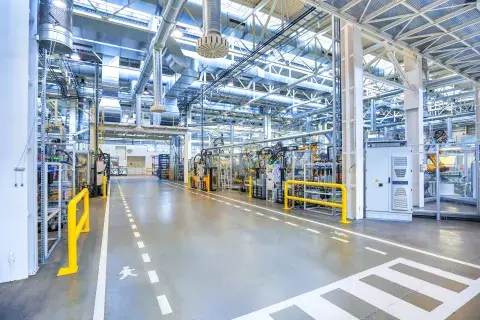
Artificial intelligence is quietly revolutionizing manufacturing across the globe, reshaping factory floors with innovations in predictive maintenance, smarter design processes, and more efficient supply chains. While the technology is still evolving, its impact is already visible in how companies manage complex operations, improve quality, and speed up decision-making.
In Waterbury, a city with a rich industrial heritage, local manufacturers like MacDermid Enthone — a key subsidiary of Element Solutions Inc., a global leader in specialty chemicals — are embracing AI as the latest chapter in their long tradition of resilience and adaptation.
MacDermid Enthone, headquartered along Waterbury’s Freight Street, stands as a prime example of the city’s manufacturing resilience.
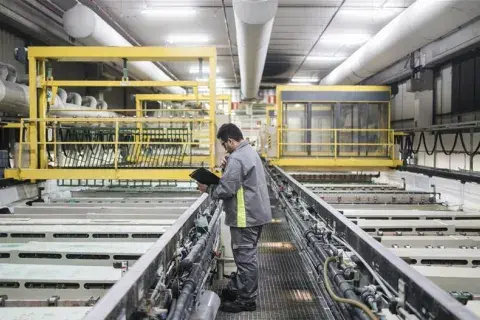
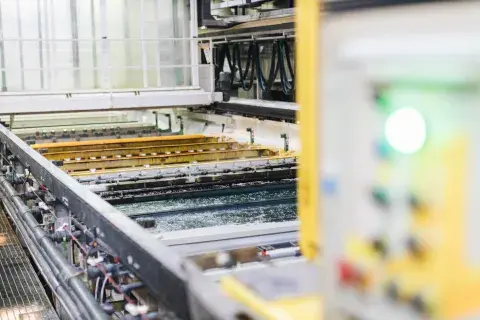
The company has successfully navigated economic shifts and evolving industries by continuously adapting and innovating. From its origins in 1922 as a traditional surface finishing business, MacDermid Enthone has grown into a global leader in advanced surface coatings — developing specialized chemistries that protect automotive parts, industrial equipment, and electronics from wear and corrosion.
“If these walls could talk, they would tell stories of unbelievable progress over the last century, all while this place has kept thriving and adapting,” said Timothy Gotsick, MacDermid Enthone’s VP Technology & Innovation.
AI Helps Companies Tackle Challenges
Artificial intelligence is becoming an everyday tool in manufacturing, even if it often goes unnoticed by the average consumer.
“AI is embedded in things like search engines or document analysis, but in our industry, we’re using it to tackle challenges like communication between different enterprise resource programs,” Gotsick said. “Our plants in Germany and the U.S. often run different systems, and AI helps us compare thousands of products and data sets quickly, freeing skilled workers to focus on more valuable tasks.”
One of the most impactful uses of AI at MacDermid Enthone lies in supply chain management. The company has developed an app that automatically reviews vendor-submitted material specifications against internal standards, cutting human review time by 80 percent.
This efficiency allows purchasing teams to focus on strategic tasks like negotiating better prices, instead of combing through technical documents.
Despite these advantages, Gotsick emphasizes the need for caution.
“There’s still a strong human factor involved,” he said. “AI can process and pre-check information, but when it comes to research or interpreting results, a human must verify to avoid mistakes. It’s still in the early days for AI in chemistry, partly because of the need to protect proprietary formulations and ensure information security.”
Gotsick said the company, especially when it comes to research, is careful to only use AI for repetitive tasks where the answers are already known.
“If you’re asking questions where the outcomes aren’t clear, like ‘What will happen if I do this?’ that’s when you can’t fully rely on AI — human insight is crucial.”
Element Solutions also operates an electronics division in Waterbury, which has seen rapid growth alongside the rise of AI-powered data centers. These massive centers require specialized chemical coatings to function efficiently — another example of how AI’s ripple effect is touching many corners of the manufacturing world.
AI Is The Newest Tool
Local companies are also forging partnerships with tech leaders like NVIDIA, leveraging advanced AI tools to accelerate product development. For instance, Watertown-based Siemon, a leader in networking hardware and an NVIDIA Solution Advisor, is harnessing AI to optimize infrastructure that supports next-generation connectivity and data transmission.
In many ways, AI is simply the newest tool in Waterbury’s long tradition of reinvention. Just as steam, electricity, and automation once transformed its factories, AI is reshaping not just how things are made, but how decisions are made, problems are solved, and resources are managed.
Gotsick believes the U.S. currently leads the world in AI technology, and it’s vital to leverage this advantage to remain competitive globally.
“There will be bumps along the way,” he said. “But AI offers tremendous opportunities to improve efficiency, enhance customer service, and unlock new possibilities — as long as we remember it’s a tool that must be managed thoughtfully.”
As Waterbury’s manufacturers step into this new chapter, they carry with them a rich history and a commitment to innovation — blending tradition with technology to shape the future of American manufacturing.
Read the full article, available in November's Manufacturing Today.