




















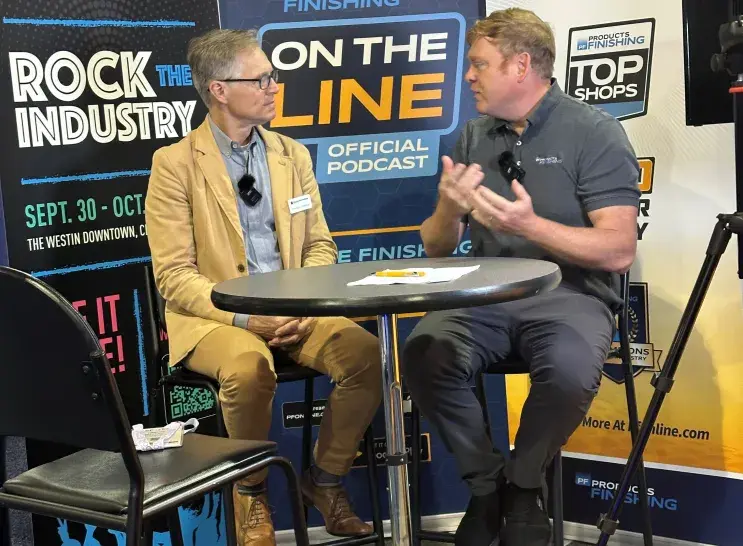
In this installment of On the Line, Products Finishing features a recent interview from this year’s SUR/FIN surface finishing industry trade show where they spoke with Timothy Gotsick, VP of Technology and Innovation, about the impact of current regulations and trade policies on the manufacturing industry. Gotsick discusses the shift away from electric vehicle (EV) manufacturing in the U.S., challenges posed by changing regulations for PFAS and hexavalent chromium, the increasing use of automation and AI in manufacturing, and ongoing challenges in the industry.
Products Finishing (PF): It's an interesting time for manufacturing. The current administration has brought new stances on regulations, trade policies, less emphasis on electric vehicle (EV) manufacturing — pretty much everything. Can you talk about the effects of some of these ongoing developments for the finishing industry?
Timothy Gotsick (TG): The industry exists within the larger society and we’ve got to adapt to whatever rules there are and the trends that are going on. So, like everyone else, we’re in the same boat, trying to figure out which direction to row every day. There’s some excitement about the possibility of manufacturing coming back into some places. We’d love to be able to serve that in the U.S. in particular.
You’re right in that some of the technology shifts have changed and are a bit regionally different. EV has definitely become a little bit less of an emphasis — particularly in the Americas. Although, I will say that in China we have a substantial business that is booming. EVs are the predominant type of automobile in China now.
In Europe, the regulations on hexavalent chromium are evolving and we’re trying to figure out where we’re going to go long term with that as well. So, it’s a pretty dynamic environment — but it means that there’s never a boring moment.
PF: Can you elaborate on the dilemma with hard chrome?
TG: Hard chrome manufacturing is incredibly important for a variety of military and industrial uses. Real technical solutions for regulatory compliance are difficult. Applicators either have to invest a ton of money in enclosing the entire thing for mist control, or they have to use a wetter [fume suppressant] and right now, PFAS materials are the only real option. And a lot of the producers of those materials have backed out of the market because of liability concerns.
So, we’re trying to continue to support the hard chrome industry worldwide by getting those materials to them [customers]. Obviously, we’re highly sensitive to the characteristics of those materials. But it’s currently top of mind because there’s a pinch point coming and there’s a society level discussion that needs to happen. We need these materials — we need the properties that can currently only be obtained with hexavalent chromium-derived hard chrome.
We also continue to have involvement with multiple areas exploring trivalent chromium as an alternative. There is progress and incremental advances in those methods, so I think there is some promise — but I can’t look you in the eye and say, “you know, in the next couple of years, you’re going to be able to get rid of hexavalent chrome and still have your hard chrome.” I think probably the most important approach right now is to find ways to eliminate PFAS from as many processes as possible.
PF: What trends in manufacturing are you paying the most attention to?
TG: One of the global trends is a continuing concern about staffing manufacturing with qualified people. Hiring people with experience, or who are coming out of an educational environment and have relevant experience, is tough. And that’s worldwide. We see that almost everywhere. Some countries are faring a little better than others, because of an emphasis on producing engineers, but it’s definitely a concern.
So, there has been a lot of automation that’s being brought into it. We’re seeing more robotics coming into the industry. AI is affecting everything in terms of your ability to analyze data and to run these systems. Of course, it’s still a developing area, and one of the questions that most people ask is, “What’s the cost benefit ratio for using AI?” At some point you need to justify it, because it’s not cheap to get into it — and so the supply chain is where we’re seeing it enter first. Whether it’s predictive maintenance or inventory management or things along those lines, we’re seeing a lot more instances of AI use, both outside our company as well as inside.
Listen to the full podcast, available now at pfonline.com.